What is forestry mulching?
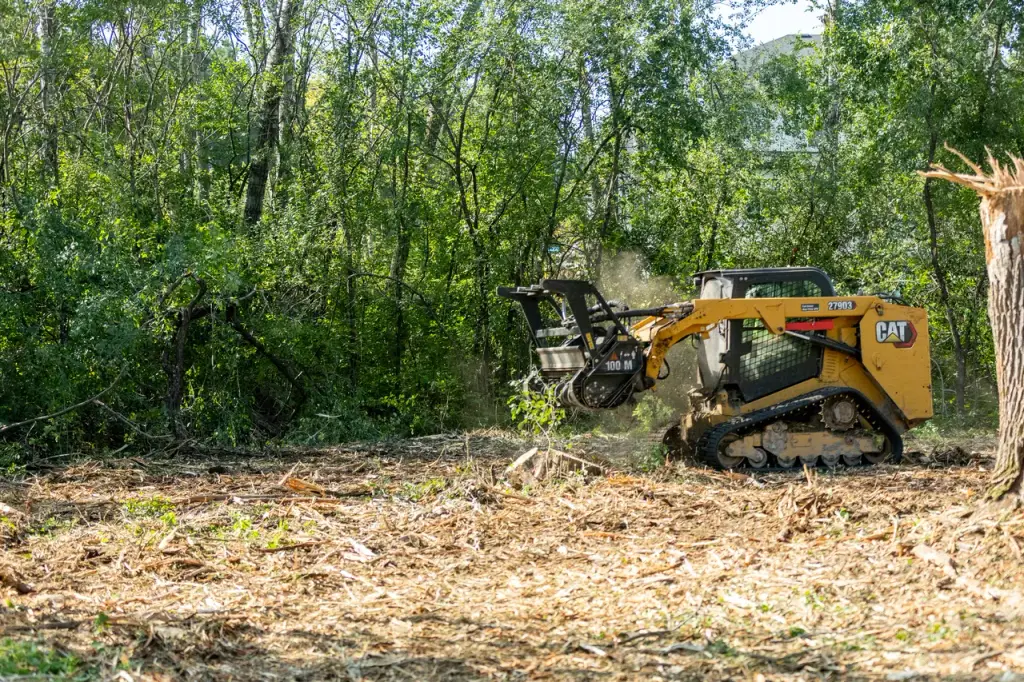
Forestry mulching is land clearing done with a single machine — a tracked loader fitted with a rotating mulcher head. Instead of cutting trees down, dragging them off, piling, and burning, the mulcher grinds standing vegetation right where it stands and leaves the chipped material on the ground.
For a lot of South Jersey property, it’s the right tool. The Pinelands grows thick: pitch pine, scrub oak, blackjack oak, greenbrier tangled through everything, mountain laurel and sheep laurel in the understory, sweet pepperbush and highbush blueberry in the damp spots. Traditional clearing turns all of that into a debris problem. Mulching turns it into mulch.
When you need forestry mulching
People call us for forestry mulching when they have:
- An overgrown lot they want to build on, or just see across again
- Acreage going back to brush that needs reclaiming for pasture, farming, or hunting
- A property line or fence row swallowed by greenbrier and scrub
- Trails — riding, hiking, or hunting access — that need cutting through the woods
- Storm or seasonal overgrowth that’s gotten ahead of them
If you can walk it and point at what you want gone, it’s probably a mulching job. If you need every root and stump pulled out below grade for a foundation or a pond, that’s excavation — and we’ll tell you so rather than sell you the wrong service.
Our process
It starts with us coming out and walking the property with you. We look at what’s actually growing, how big it is, where the wet spots and the good trees are, and how we get the machine in and around. Then you get a straight estimate.
On the day, the machine goes to work. The mulcher head takes brush and stems down and grinds them into the soil line. We work selectively — if you want a stand of pitch pine or a few good oaks left standing, they stay. When the cutting’s done, we clean up the edges and transitions so the finished area looks intentional, not abandoned.
What to expect
Most residential lots and small-acreage jobs run a day or two. Heavier, woodier growth or larger parcels take longer, and we’ll give you a realistic window after we’ve seen it.
Ground conditions matter. The sandy Pinelands soil drains well, which helps, but after a hard rain some low areas and cedar-swamp edges stay soft. Tracked equipment spreads its weight and handles soft ground better than wheels, but we’ll still time the work to protect your property and avoid rutting.
When we’re done, you’ll have cleared ground under a layer of mulch — not bare, scraped dirt. That mulch holds moisture, cuts down erosion, and breaks back into the soil over the seasons.
What it costs
We don’t post flat prices, because they’d be wrong for your lot. What drives the cost is real: how dense the brush is, how big the stems are, the terrain, and how easy it is to get equipment in and maneuver. A clean acre of light underbrush is quick. A tangled acre of mature scrub oak and greenbrier is a different job.
What we will do is give you a free, honest estimate after we’ve walked the property, and explain what’s behind the number. That transparency is the whole point — you should know what you’re paying for.
Forestry mulching vs. brush hogging — which do you need?
People often shop these two against each other, and the price gap is real, so it’s worth understanding the difference before you choose.
Forestry mulching uses a tracked machine with a drum mulcher to grind standing brush and small trees into fine mulch in a single pass. It leaves a clean, finished surface with nothing to haul, works under a tree canopy without damaging the mature trees, and handles dense woodland. It costs more and goes slower — you’re paying for the finish and the ability to work heavy growth.
Brush hogging uses a tractor-mounted rotary cutter to knock down grass, weeds, and brush in open fields and pastures. It’s faster and considerably cheaper, but it leaves chunks of cut material on the ground rather than fine mulch, and it’s built for open ground, not dense woodland under a canopy.
The short version: choose forestry mulching for dense woodland, a clean finished result, or site prep for development and landscaping. Choose brush hogging for an open field or pasture where budget matters and a rougher finish is fine. If you realize you want the cheaper, rougher option, head over to our brush hogging page — we’d rather send you to the right service than sell you the wrong one.
Pinelands permits
A lot of this area sits inside the Pinelands National Reserve, and larger clearing projects can require approval from the Pinelands Commission. As locals who farm here, we’re familiar with how that works and can help you figure out whether your project needs it before we start — better to know going in than to find out after.
Serving your area
We run forestry mulching out of Pemberton across Burlington County and into Ocean, Atlantic, and Camden. See the service areas for your town, or just call and ask.