When to choose brush hogging
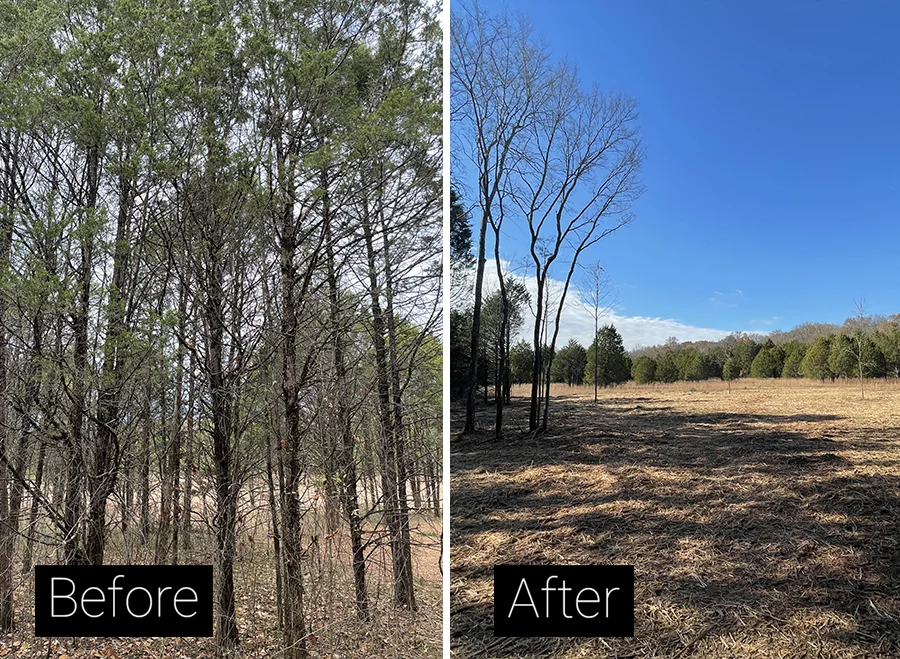
Brush hogging is the right call when you have open ground that just needs to be knocked down — a field gone to weeds, a pasture filling in, a fence line disappearing under brush, or a large lot you maintain once a year. It is faster and more economical than forestry mulching, and for a lot of South Jersey property that is exactly what the job calls for.
Reach for brush hogging when:
- You have an open field, pasture, or large lot that needs to be knocked back
- You’re maintaining property on a schedule — a firebreak, a view, a pasture
- The material is mostly grass, weeds, and brush under about 2 inches in diameter
- You don’t need a fine, mulched finish — leaving cut material on the ground is fine
- Budget is a primary concern
Forestry mulching is the better choice when the vegetation is dense woodland with saplings and small trees, when you want a clean mulched finish with no debris left behind, when you’re prepping a site for development or landscaping, or when you need to clear under a tree canopy without damaging the mature trees. The trade-off is straightforward: brush hogging is quicker and cheaper with a rougher result; mulching is slower and costs more with a finished result.
Not sure which way to go? Start at our brush clearing overview, or just call and describe the property — we’ll tell you honestly which approach fits.
Our equipment for brush hogging
We run a tractor-mounted rotary brush hog cutter — the right tool for fields, pastures, fence lines, and large open areas. The rotary cutter knocks down brush, saplings, and tall grass efficiently across a lot of ground in a short time. Because it cuts rather than grinds, chunks of cut material remain on the ground instead of being reduced to fine mulch. That’s the nature of the tool, and for open maintenance work it’s not a drawback — the material breaks down in place over the season.
For property that needs a cleaner result, we bring different equipment: a tracked machine with a drum mulcher for fine-finish forestry mulching, a flail mower for a tidy finish on grass and light brush, and a skid steer with attachments for residential yard clearing. Matching the machine to the job is the whole point.
Pricing for brush hogging in South Jersey
Brush hogging typically runs $150 to $400 per acre, depending on:
- Density of growth — light grass moves fast; dense brush with saplings is slower
- Terrain — a flat, dry field versus uneven, wet, or sloped ground
- Access — easy road frontage versus a remote back pasture
- Total acreage — larger jobs earn better per-acre rates
- Travel distance from our Pemberton base
For smaller jobs under one acre, minimum pricing starts at $300. Annual maintenance contracts are available at preferred rates for fields, firebreaks, and pastures that need a regular pass. Every number comes after a free site visit, with a plain explanation of what’s behind it — no flat online pricing, because no two fields are the same.
Service area
We brush hog across Burlington, Ocean, and Atlantic counties, working out from Pemberton — most jobs are within about an hour of home base. That includes towns like Pemberton, Southampton, Tabernacle, Shamong, Vincentown, Medford, Hammonton, Manchester Township, and Jackson Township. Find your town on our service areas page, and see examples of our work in the gallery.
What we don’t do
We’d rather be clear about scope up front:
- We don’t brush hog terrain with significant rocks, stumps, or hidden debris — those damage the cutter, so we’ll flag them and suggest another approach
- We don’t run when the ground is saturated, because it ruts and damages the field — we time the work for conditions
- We don’t haul away the cut material — brush hogging leaves it on the ground. If you want a clean finish with nothing left behind, forestry mulching is the alternative
Ready to get a field or fence line knocked back? Call (609) 755-3269 or request a free quote. Hablamos español. Falamos português.