Which brush clearing service do you need?
“Brush clearing” covers a range of work, and the right approach depends on what you’ve got and what you want left behind. If you’re not sure which one fits, start here — or just call and describe the property, and we’ll point you the right way.
- Brush hogging — fast, economical knockdown of open fields, pastures, and fence lines with a tractor-mounted rotary cutter. Best when budget matters and you don’t need a fine finish.
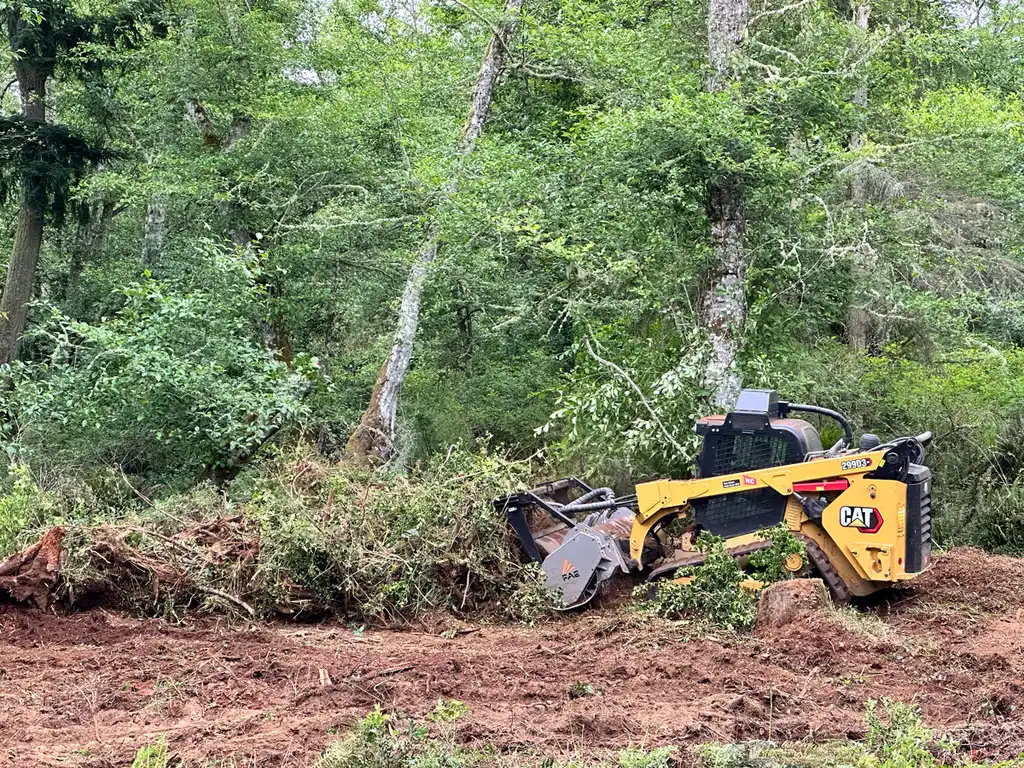
- Forestry mulching — a tracked machine grinds dense woodland, brush, and small trees into clean mulch in one pass. Best for a finished result or prepping a site for a new use.
- Yard clearing — residential-scale work, from $300, for overgrown yards, side lots, and easements most contractors won’t take.
- Brush and tree removal — when trees up to 6 inches are part of the job, ground into mulch on-site, with honest coordination for anything larger.
- Bushes and shrub removal — pulling overgrown foundation plantings, hedges, and invasive shrubs for landscaping work.
The overview below covers brush clearing in general. If that’s what you need — the understory knocked back, the mature trees kept — read on.
What brush clearing is
Brush clearing is about the understory — the layer of greenbrier, scrub oak, saplings, laurel, sweet pepperbush, and tangled overgrowth that fills in under and between the trees. It’s the stuff that makes a woods impassable, harbors ticks, builds up fire fuel, and slowly chokes out the trees you actually want.
We clear it with a mulcher head, grinding it down to the soil line and leaving the material as a mulch layer. The mature trees stay. What changes is you can walk your property again, see through it, and breathe.
When you need brush clearing
Common reasons people call:
- The greenbrier and scrub have made the property impassable
- Sightlines are gone — you can’t see across your own land
- Tick and pest habitat is creeping toward the house
- Dry brush has built up into a fire concern
- You want to open the understory of a woodlot while keeping the trees
- A trail, fence line, or field edge is closing in
Selective by design
The whole point of brush clearing is that it’s selective. We take out the understory tangle and leave the canopy. Mark the trees you want kept and they stay. This is where knowing the local vegetation pays off — we know which brush is worth pulling, which trees to protect, and how to open the floor without stressing the roots of your good timber.
Our process
We walk it with you, look at how thick the underbrush is and what’s growing, and check access. You get a free estimate. Then we clear — working around standing trees, grinding the brush in place, and cleaning up the edges. You’re left with an open, walkable understory and a mulch layer over the ground.
What to expect
Brush jobs often go quicker than full clearing since we’re working the understory rather than taking down trees, but density is everything — a wall of mature greenbrier and scrub is slow going. We’ll give you a realistic timeframe after we see it. The tracked machine keeps ground impact low, and we time the work around wet conditions.
Expect some regrowth over time from species like greenbrier and scrub oak — that’s their nature. One pass sets it back hard; keeping it down is a maintenance conversation we can have.
Pricing
Cost tracks with how dense the brush is, the size of what’s in there, the terrain, and access. Free estimates, explained plainly, no flat pricing.
Brush clearing pairs naturally with trail cutting, right-of-way clearing, and forestry mulching. Check your service area.